I haven’t written a blog post for a while. Why the silence?
One reason is that this is a period in my life with a lot of inner movement. I’m turning 50 this autumn and that feels like a profound transition. There are parts of me overflowing with the desire to connect, to share inquiries, to exchange stories, to be in community. But other parts have been urging slowness and privacy — holding back.
Maybe you recognize it: that challenge of figuring out in what shape or form you can keep moving forward as a whole? When different parts of you want to head in radically different directions?
The last time at this juncture, I wrote about beginning again. That theme is still so relevant to academic life as a whole, and to the writing life. Who hasn’t lost their place with a text or project and needed to find a way to begin again?
This time, my reflections are on “holding back” as an academic and a writer. Maybe that’s the companion piece to beginning again? In any case, I hope there’s something interesting in this for where you are finding yourself.
“I think you could write more”
Writing more, publishing, being visible, having a voice — these are almost universally held as good things to be doing. That we’d encourage ourselves and each other “not to hold back” on this front is so common it barely registers as a choice.
And yet, for some, this message cuts a little more sharply than it does for others.
That may be the case if, like me, you’re the sort of person for whom holding back is a familiar way of moving through the world.
Some moments from my academic life:
-1-
Years after my tenure track contract was terminated in 2012, an academic friend who was there at the time visited me in my new town.
She said she’d seen the debacle coming: “I was concerned for you, you were so unwilling to compromise. You could have collaborated on articles to get some publications early on, but you were holding out for the deep and meaningful contributions.”
-2-
In the college where I worked post-tenure track, I was coauthoring a journal article with another academic friend. Looking over a draft, he paused and said gently: “You do this very well. I think you could write more.”
-3-
The director of the school where I worked as a postdoc called me in for a meeting ahead of a major national research assessment. We talked about the main article from my PhD thesis I had slowly been developing for submission to a journal. “Don’t hold onto it, make sure it gets published,” he said. “Nothing is more important.”
I walked back to my desk with a premonition of what was to happen. Instead of speeding up, the work on that article slowed down. It was eventually published years later, in a different job.
- Holding out.
- You could write more.
- Holding on.
There are familiar names for this holding back tendency: perfectionism, procrastination.
But that’s not how I want to relate to myself and my experiences. I don’t want the well-worn thinking paths — the opinions, the judgement, the advice — that come with those terms.
I’d rather stay in a more open-minded curiosity about what it is like to hold back. Beginning with what it is like in my body.
Holding back as embodied experience
Let your hands come in towards your chest.
Keep your shoulders relaxed, let your elbows point down softly and let your palms face your chest without touching it.
Notice the space between palms and chest — enough space to hold some flowers, a loaf of bread, or a little kitten. Let your chin nod forward so you can look into that space.
Notice how your hands make a barrier between outside and inside.
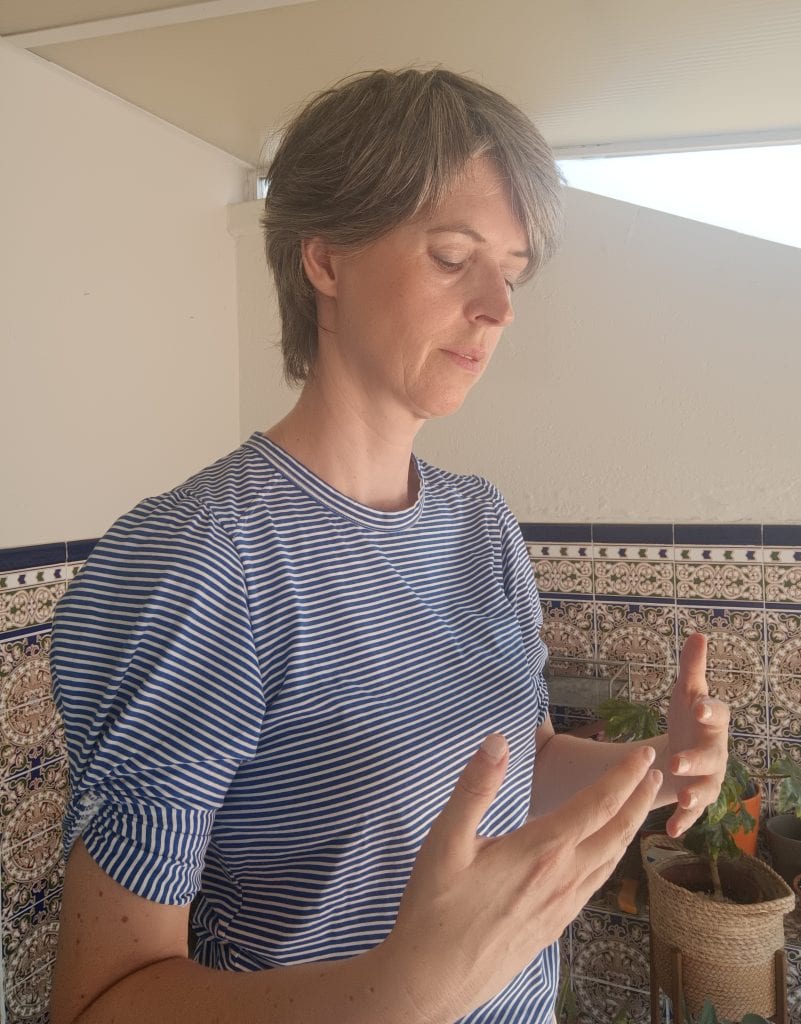
That’s one form holding back might take — one in which I recognize myself. For me, with the right distance between hands and chest, this is posture of comfort. More than that: it is a solid shape in which I feel grounded, my breath can flow and my thoughts can flower.
Let’s call this “Holding it close to the chest.”
Now try moving forward while also being pulled back.
Like a sputtering. A bit of forward movement, abruptly stopped and pulled back. Then a sputtering forward again.
-> Do it.
<- Don’t do it. Take your time.
-> This needs to move now. You’re missing chances.
<- Not now. Not like this.
->
<-
Notice the qualities of the movement — jerky, jagged, restless?
Notice where you feel tension in your body: maybe your belly, your throat, your shoulders.
That’s another form holding back might take — one in which I recognize myself as well. This one is uncomfortable; there’s a knot in my stomach and there’s no place to rest.
Let’s call this “the sputter pattern.”
Living with a paradox
There can be other shapes for holding back; I think as many as there are distinct experiences.
What I like about touching in with the two varieties above is that they show me something I already knew but don’t always remember.
Holding back is a form of homecoming for me, as well as a form of suffering.
It has the sweetness of feeling alive as me.
It also has the sting of running into a familiar pattern; one that keeps me from living full out.
What is it to live with that paradox?
My best response so far is to make room for both sides. To allow myself the sweetness of holding things close. And keep looking for ways to suffer the sputter-pattern a little less.
I’m close to the ground and down in the dirt on this last one: I accept that the pattern is strong and there will be more suffering. But I also know there is nuance in lived experience: the pattern is evolving (ever so slightly) all the time and it responds (even if just a little) to experimentation.
I do need — always need — community: voices in my ear that offer lifelines, words in which I can recognize myself, ways of making sense that I can test the resonance of in my nervous system.
Here’s one for each side of the paradox:
Honesty as a way forward
In a little advice book for artists titled Show Your Work!, Austin Kleon talks about learning and creating in public.
Share what you can share, is Kleon’s message. And what you can always share is your process. Don’t hold out for the end product. Share early and often. Let people see.
In principle, I love this: the invitation to be honest about wherever I am and whatever I’m thinking about, and to tell stories about ongoing learning.
In practice, doing this feels complicated for me. If you’re talking with me one-on-one, then absolutely. But in groups, or in public, I often keep my thoughts to myself until they are well-formed and I feel that I know who I am talking to.
Yet there is something about honesty as a fallback to which my sputter pattern responds well.
Maybe because the invitation to be more honest — about what I can say, about what I really want to say, about what’s really here — reconciles the clashing instincts that pull me forward and back? Because I can go back to honesty and let that bring momentum for moving forward?
I’m not really sure. But I do know that honesty can sometimes smoothen the path to sharing for me. It did so in writing this post.
Singing the praises of restraint
The psychotherapist and soul-activist Francis Weller speaks about holding back in a positive way in recent essay on restraint (in his book In the Absence of the Ordinary).
“Restraint,” Weller writes,
“may not be as sexy as courage and boldness. Nor is it the most popular at the party. Exuberance and abundance get that award. Restraint is more introspective, contained, and held back. It is a bit austere, preferring not doing to doing.” (pp.77-8)
Despite its negative rap, Weller suggests restraint can be a useful quality to cultivate. Among other things, it means trusting more deeply in the cyclical movements of life, in which both holding back and giving out have their place.
“We must grant time and space for things to ripen and mature. Insights, intuitions, encounters, and dreams, all require time to incubate and consolidate into something substantial. We continually reveal and share things too soon […]. We need to hold, contain, and cook the material before sharing it with the world. […]
The value of restraint acknowledges this truth and creates a space where something can take shape according to its nature.” (p.78)
I love that: “a space where something can take shape according to its nature.”
What else is that space in front of the chest, securely held by hands and arms, but a space where my material is being cooked?
I’m encouraged by the reminder that holding back is part of a healthy dynamic of growing, learning, and creating. Weller’s words also bring me to a place where I’m suddenly a little less focused on my struggles with holding back. In their place, memories rush in of moments when I released something into the world not so much because I overcame my limitations, but because it was ready to see the light of day.
On we go
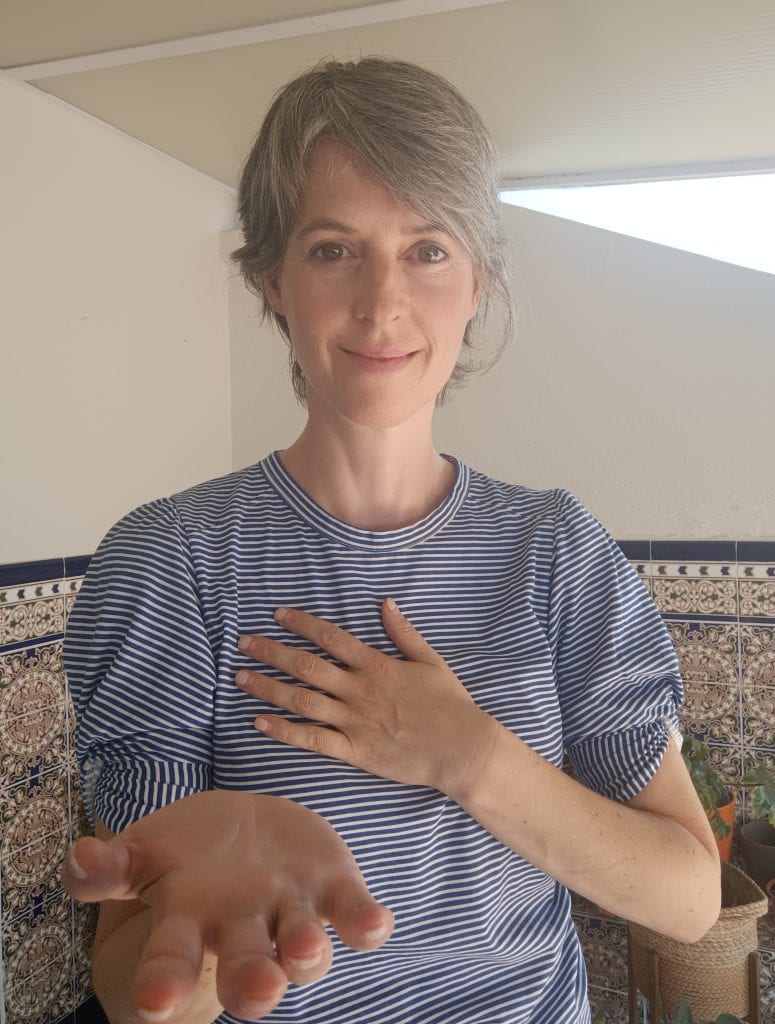
As I’m getting ready to hit “send” on this, this photograph expresses the feeling.
I hope there’s something here for you. I would love to hear what comes up for you in response, if you feel inclined to share.
Image credit (top):
Staying inside, looking out, by Jason Leung


